Launch offer — valid today only

📄 Digital book in PDF · read it on your phone or print it

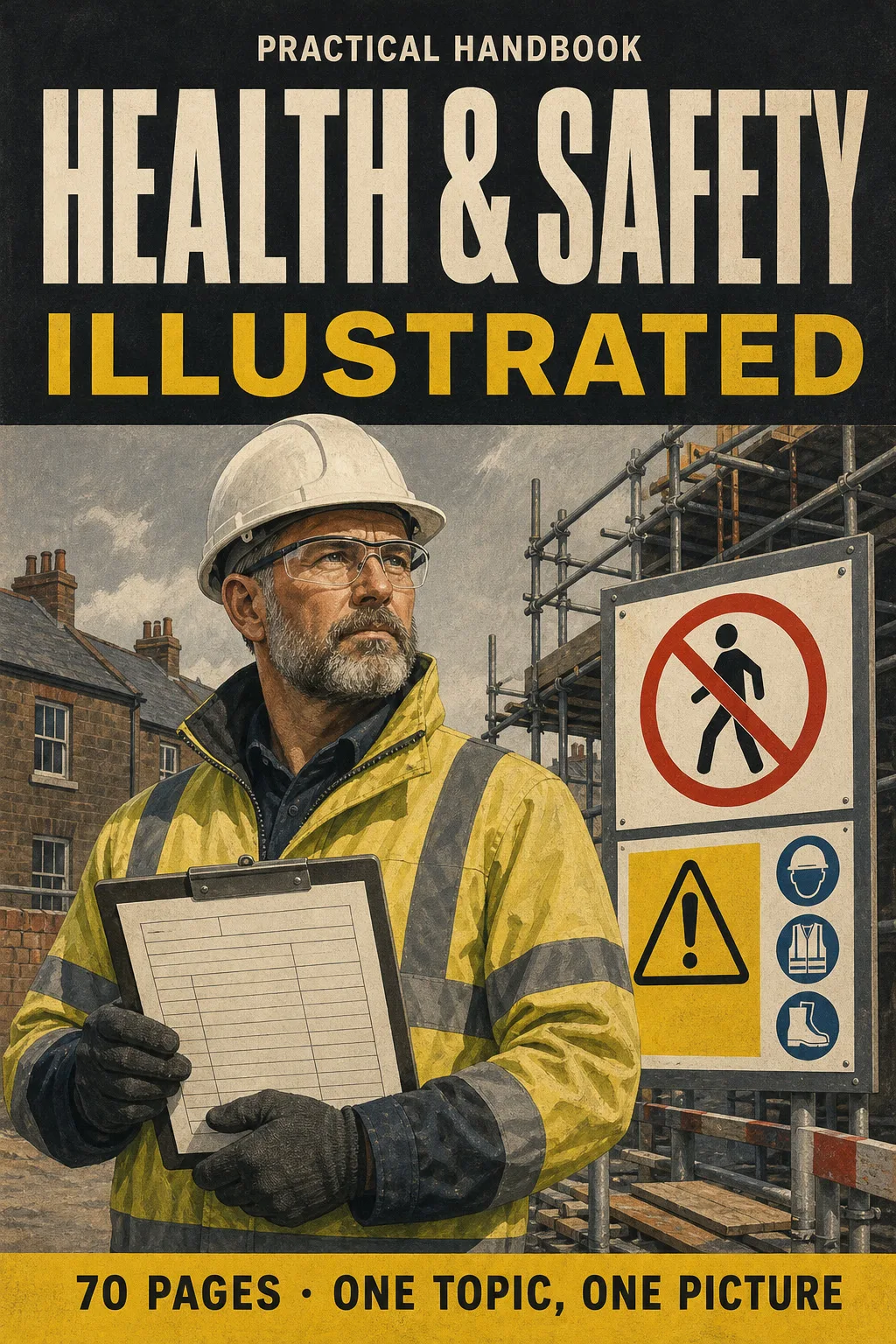
UK Health and Safety in Drawings: Every Duty in Order, from the 1974 Act to RIDDOR One Topic on Every Page

Risk assessment in 5 steps, the hierarchy of control, COSHH, RIDDOR, working at height, manual handling, PUWER and fire safety. Every topic has its own page: the drawing first, then what you need to remember. 70 illustrated pages.

START STUDYING THIS WAY

🔒 Secure checkout · PDF by email · 30-day guarantee

Every topic, its own pageEach duty and each rule drawn, with the explanation alongside
70 illustrated pages8 parts, from hazard vs risk to the scenario question
Up-to-date sourcesHSWA 1974, RIDDOR 2013, COSHH 2002 and HSE guidance
PDF by emailFormat

Look Inside the Book

Every page has one big drawing and a box with the numbers, rules and steps you need to know:

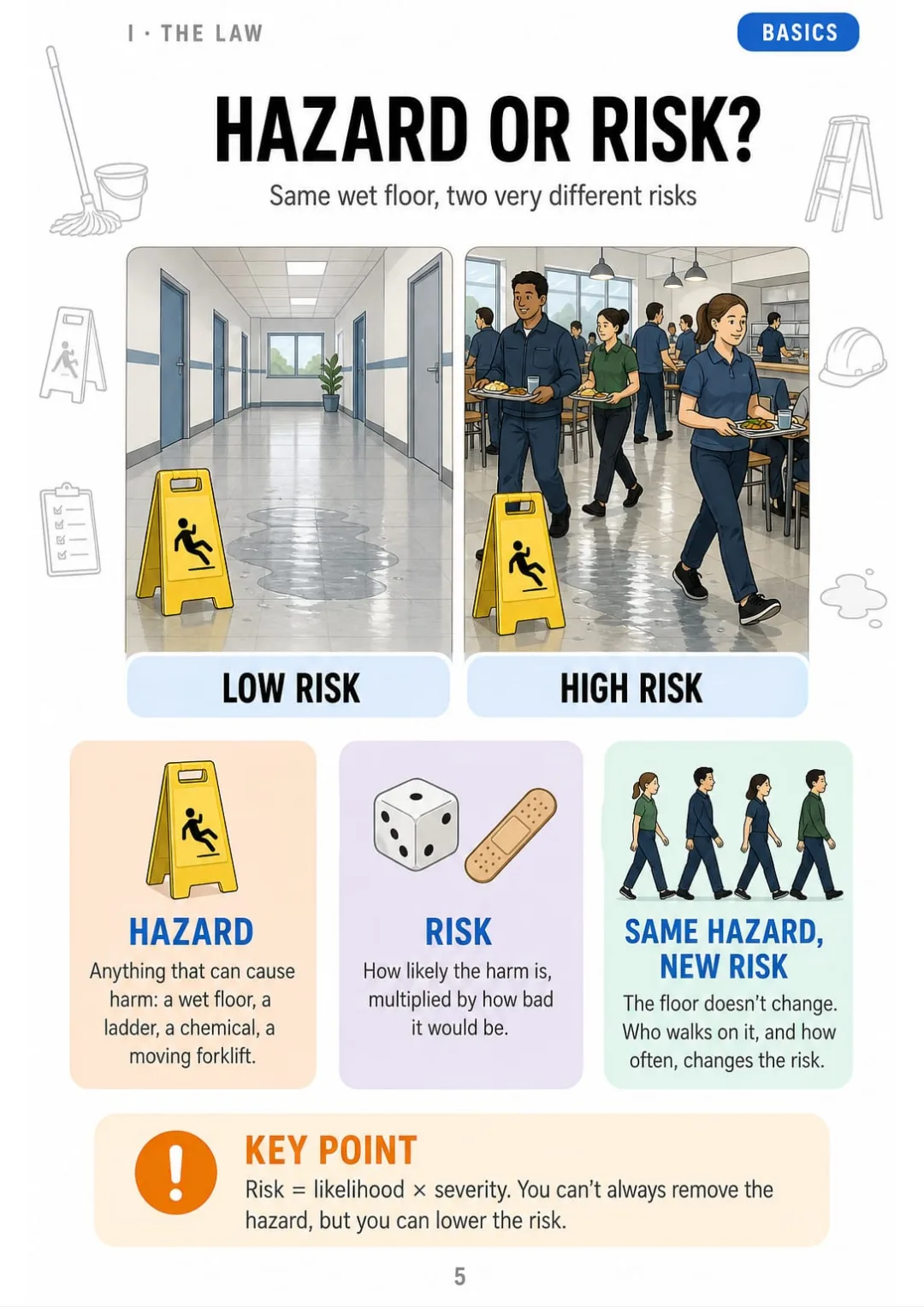
Hazard vs risk: the same wet floor, empty corridor or busy canteen.
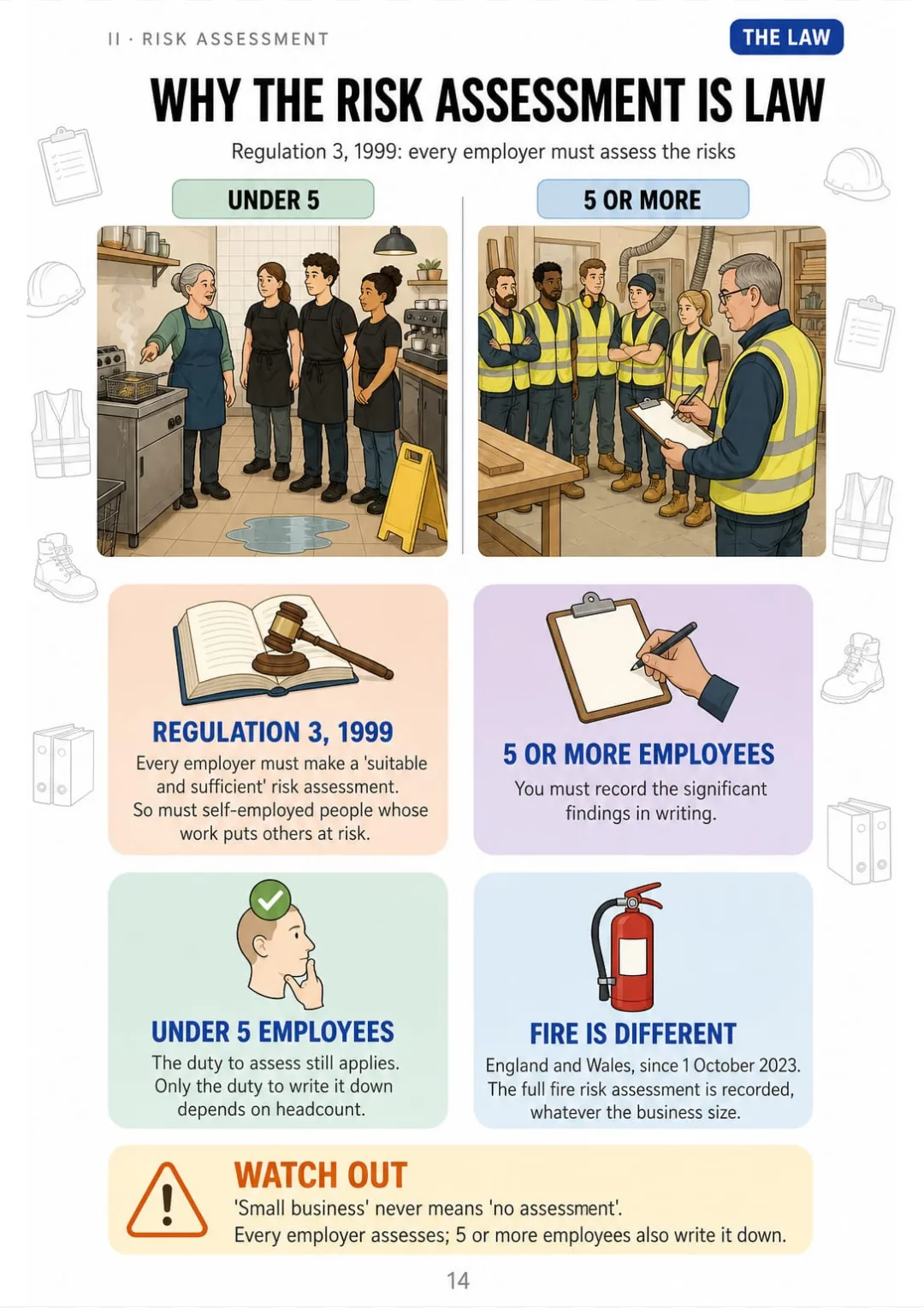
Management Regs 1999, reg 3: suitable and sufficient assessment; written with 5 or more employees
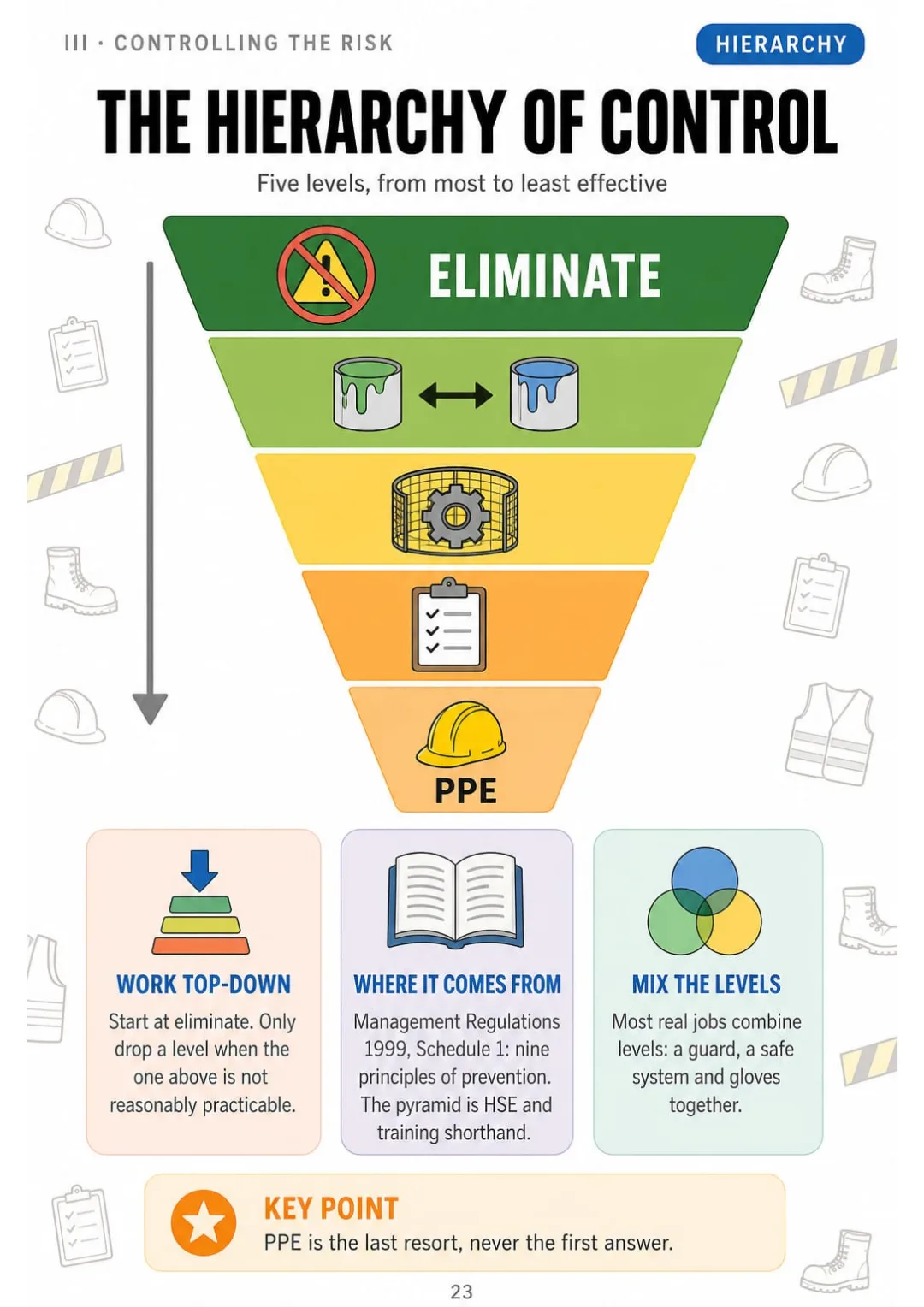
Eliminate → substitute → engineering → admin → PPE: one pyramid, best control at the top.
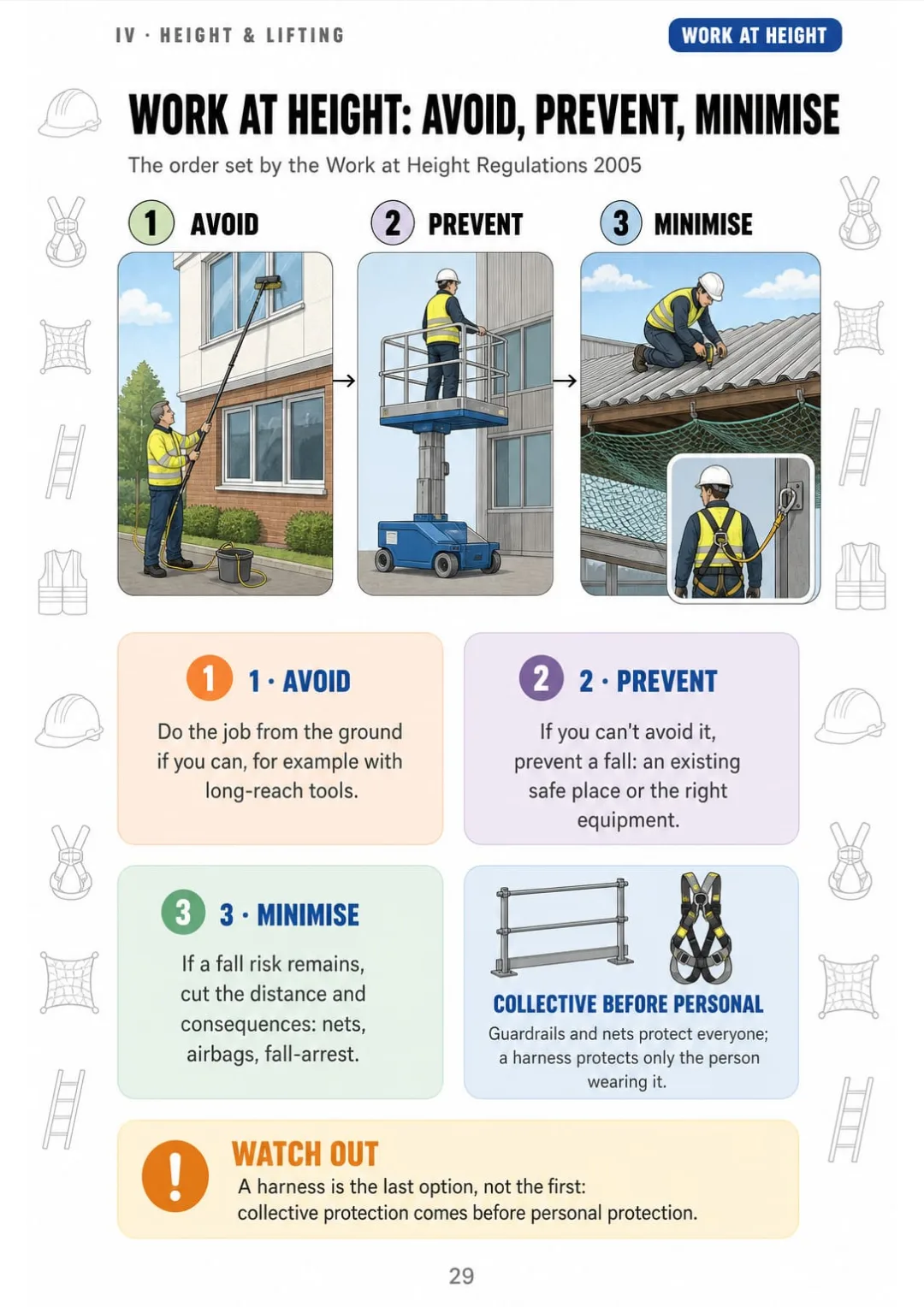
Work at Height Regulations 2005, regs 6 and 7: avoid → prevent → minimise, collective before personal
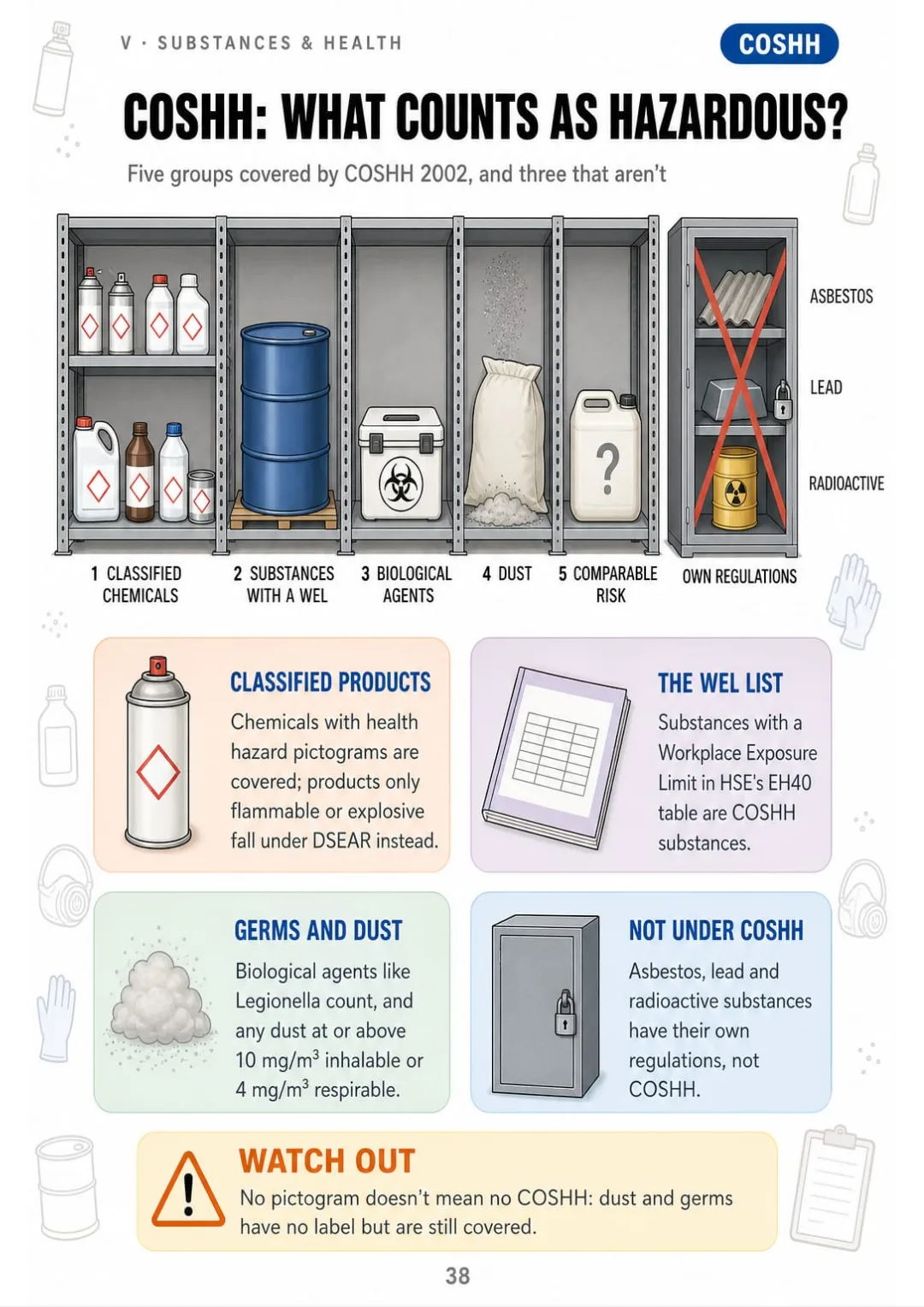
COSHH 2002: classified chemicals, EH40 substances, biological agents, dust and comparable risks.
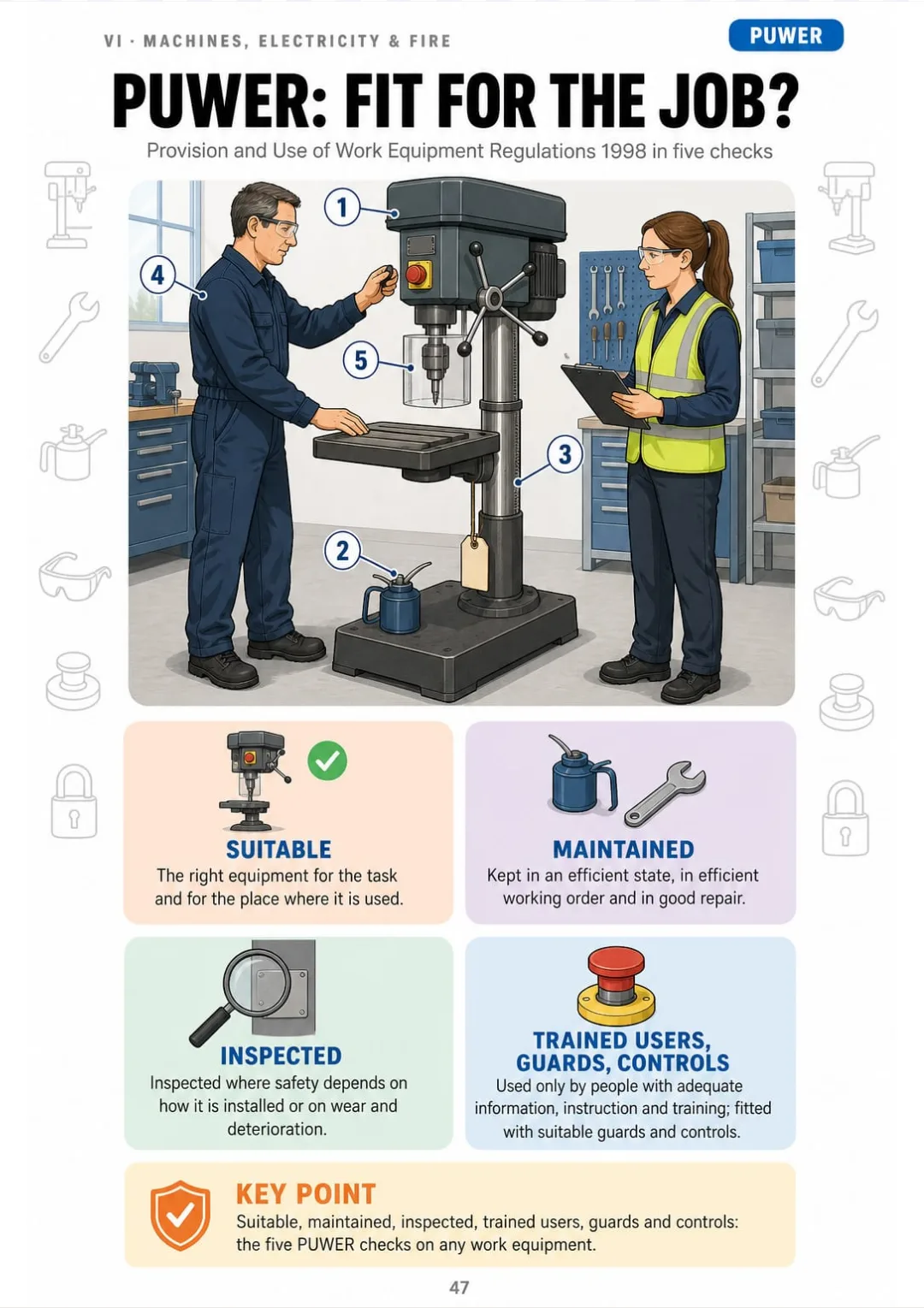
PUWER 1998: suitable, maintained, inspected, trained users, guards and controls
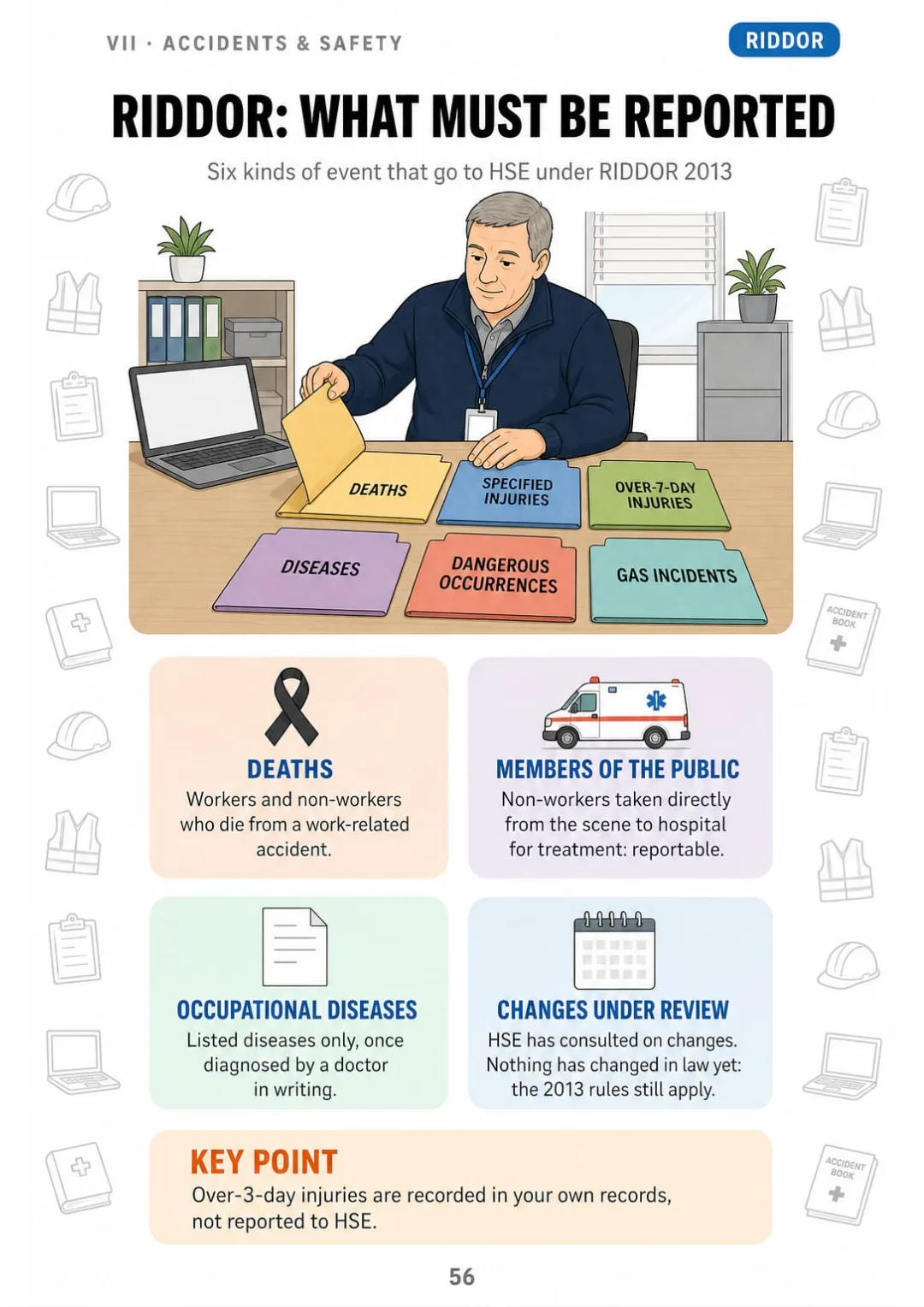
RIDDOR 2013: deaths, specified injuries, over-7-day injuries, diseases, dangerous occurrences, gas incidents
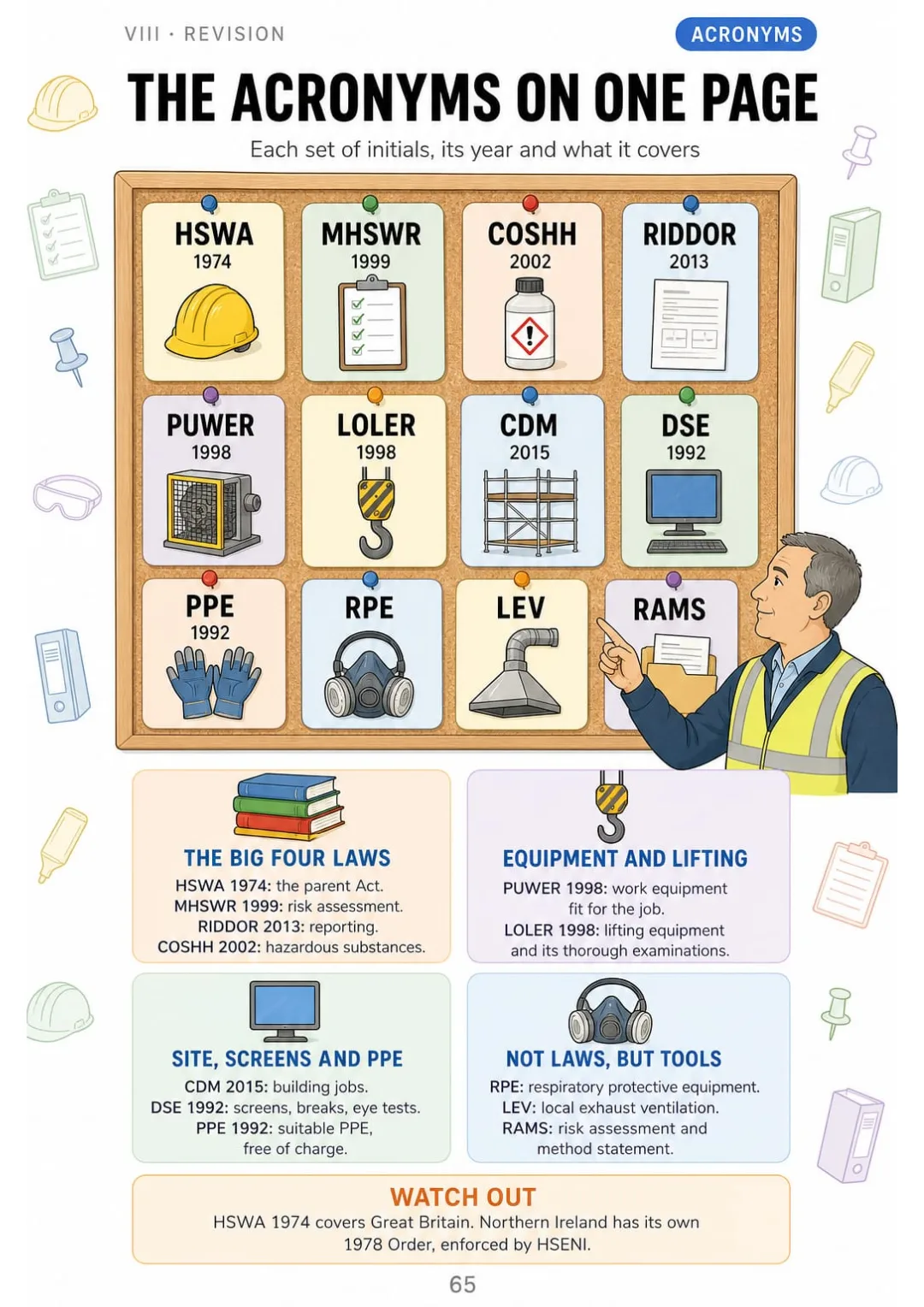
HSWA 1974, COSHH 2002, RIDDOR 2013, LOLER 1998: every acronym with its year

Swipe to see more →

These are real pages from the book. The table of contents is the full one: 8 parts and 66 topics.

The Problem Isn't You. It's How It Was Explained to You.

You're on the course and the trainer puts up a scenario with dusty cutting work: what's your first control? And your mind goes straight to masks.

Your manual covers the hierarchy of control in three dense paragraphs: elimination, substitution, engineering controls, administrative controls, personal protective equipment. Five terms in a row, with nothing to hang them on.

Eliminate → substitute → engineering → admin → PPE: one pyramid, best control at the top.

In the book, the same topic is one pyramid. Eliminate at the top, PPE at the bottom, a small drawing on every level. Best control at the top, last resort at the bottom: you see it in a second.

Every other topic gets the same treatment: the 5 steps of a risk assessment, what COSHH covers, what RIDDOR asks you to report, the ladder at 1 in 4, the extinguisher colour bands.

Next time someone asks, you start at the top of the pyramid and work down. No flicking back through the manual.

COMPARE FOR YOURSELF

The Same Topic, Two Ways to Study It

THIS
  • The manual: line after line
  • Legal duties explained with words alone
  • You arrive at the exam still unsure
Regulation 3 of the Management of Health and Safety at Work Regulations 1999 requires every employer to make a suitable and sufficient assessment of the risks to the health and safety of employees to which they are exposed whilst at work, and of the risks to persons not in their employment arising out of or in connection with the conduct of the undertaking, for the purpose of identifying the measures required to comply with the relevant statutory provisions. Where five or more employees are employed, the significant findings shall be recorded.
FOR THIS
  • The risk assessment duty in one drawing
  • The regulation and the 5-employee rule in a box
  • You see it and it makes sense
Management Regs 1999, reg 3: suitable and sufficient assessment; written with 5 or more employees
CONTENTS

Take a Look at the 8 Parts and 66 Topics

The law, risk assessment, controlling the risk, height and lifting, substances and noise, machines and fire, accidents and reporting, and revision for the exam: 70 pages, all illustrated.

IThe Law in Plain Words · pp. 5-13
  1. Hazard or risk: what's the difference?
  2. What does the 1974 Act ask of the employer?
  3. What does the Act ask of the worker?
  4. Who else is the employer responsible for?
  5. 'So far as is reasonably practicable': what does it mean?
  6. Acts, Regulations, ACoPs and guidance: which is which?
  7. Who enforces the law?
  8. Improvement notice or prohibition notice?
  9. What must every workplace have on the wall and on file?
IIRisk Assessment in 5 Steps · pp. 14-22
  1. Why is the risk assessment a legal duty?
  2. The 5 steps on one page
  3. Step 1: how do you find the hazards?
  4. Step 2: who might be harmed, and how?
  5. Step 3: how do you rate a risk?
  6. Step 4: what goes in the record?
  7. Step 5: when do you review it?
  8. Worked example: a warehouse loading bay
  9. Risk assessment or method statement?
IIIControlling the Risk · pp. 23-28
  1. The hierarchy of control as a pyramid
  2. Eliminate and substitute: the top of the pyramid
  3. Engineering and admin controls
  4. PPE: why is it last on the list?
  5. What is a permit to work?
  6. Safety signs: what do the shapes and colours mean?
IVHeight, Lifting and Moving · pp. 29-37
  1. Work at height: avoid, prevent, minimise
  2. The ladder: the 1 in 4 rule
  3. Guardrails and toe boards: the numbers
  4. When must a scaffold be inspected?
  5. Fragile roofs and falling objects
  6. Manual handling: avoid, assess, reduce
  7. TILE: the four things to assess
  8. How much can you lift? The HSE guideline figures
  9. Vehicles and forklifts in the workplace
VSubstances, Noise and Health · pp. 38-46
  1. COSHH: what counts as a hazardous substance?
  2. The 9 hazard pictograms
  3. The safety data sheet: where to look
  4. COSHH in the workshop: a worked scene
  5. Silica and wood dust on site
  6. Asbestos: when should you suspect it?
  7. Noise: 80, 85, 87
  8. Hand-arm vibration: 2.5 and 5
  9. Stress and display screens
VIMachines, Electricity and Fire · pp. 47-55
  1. PUWER: is the equipment fit for the job?
  2. Machine guards: fixed, interlocked, adjustable
  3. LOLER: lifting equipment and its thorough examinations
  4. Electricity at work: 110 V on site and the 30 mA RCD
  5. Safe isolation: lock off, tag, test
  6. Underground and overhead cables
  7. The fire triangle and the fire risk assessment
  8. Which extinguisher? The colour bands
  9. Fire classes and escape routes
VIIAccidents, Reporting and Managing Safety · pp. 56-64
  1. RIDDOR: what must be reported?
  2. RIDDOR deadlines: without delay or within 15 days
  3. Specified injuries: the list
  4. Dangerous occurrences: the near misses you must report
  5. Accident investigation: immediate, underlying, root cause
  6. First aid at work
  7. CDM 2015: who does what on a building job?
  8. Plan, Do, Check, Act
  9. Consulting the workforce and the toolbox talk
VIIIRevision and Ready for the Exam · pp. 65-70
  1. The acronyms on one page
  2. The numbers to have at hand
  3. The most frequent mistakes in a risk assessment
  4. Before the shift: the supervisor's checklist
  5. When the inspector arrives
  6. How to answer a scenario question

One Page, One Topic, All Clear

Think of it this way:

Monday morning, a new cleaning product arrives at the workshop and someone asks whether it falls under COSHH. You need the answer before the tin is opened.

You open the COSHH page and it's drawn: classified chemicals, substances listed in EH40, biological agents, dust. A few boxes, and you know where that tin belongs.

COSHH 2002: classified chemicals, EH40 substances, biological agents, dust and comparable risks.

Same with RIDDOR, the ladder at 1 in 4, noise at 80, 85 and 87 dB(A), LOLER thorough examinations and the fire triangle: each one on its own page.

Health & Safety Illustrated is 8 parts and 66 topics, all drawn, with a final revision part: every acronym, the numbers to have at hand and how to answer a scenario question.

What you see drawn, you don't have to memorize.

What's Inside Health & Safety Illustrated:

Ipp. 5-13

The Law in Plain Words

Hazard and risk, what the 1974 Act asks of employers and workers, 'reasonably practicable', who enforces the law, improvement and prohibition notices.

IIpp. 14-22

Risk Assessment in 5 Steps

Why the risk assessment is a legal duty, the 5 steps one by one, rating a risk, the record, the review and a worked loading bay example.

IIIpp. 23-28

Controlling the Risk

The hierarchy of control as a pyramid, eliminate and substitute, engineering and admin controls, PPE, permits to work and safety signs.

IVpp. 29-37

Height, Lifting and Moving

Work at height, the ladder at 1 in 4, guardrails, scaffold inspections, fragile roofs, manual handling with TILE, lifting figures and forklifts.

Vpp. 38-46

Substances, Noise and Health

What COSHH covers, the 9 hazard pictograms, the safety data sheet, silica and wood dust, asbestos, noise, vibration and display screens.

VIpp. 47-55

Machines, Electricity and Fire

PUWER, machine guards, LOLER, 110 V on site and the 30 mA RCD, safe isolation, buried and overhead cables, fire and extinguisher colour bands.

VIIpp. 56-64

Accidents, Reporting and Managing Safety

What RIDDOR asks you to report and by when, specified injuries, dangerous occurrences, accident investigation, first aid, CDM 2015 and toolbox talks.

VIIIpp. 65-70

Revision and Ready for the Exam

Every acronym on one page, the numbers to have at hand, frequent risk assessment mistakes, the supervisor's checklist and scenario questions.

At the end of the book: A revision part with every acronym and its year, the numbers to have at hand and how to answer a scenario question.
Plus: 2 Free Books

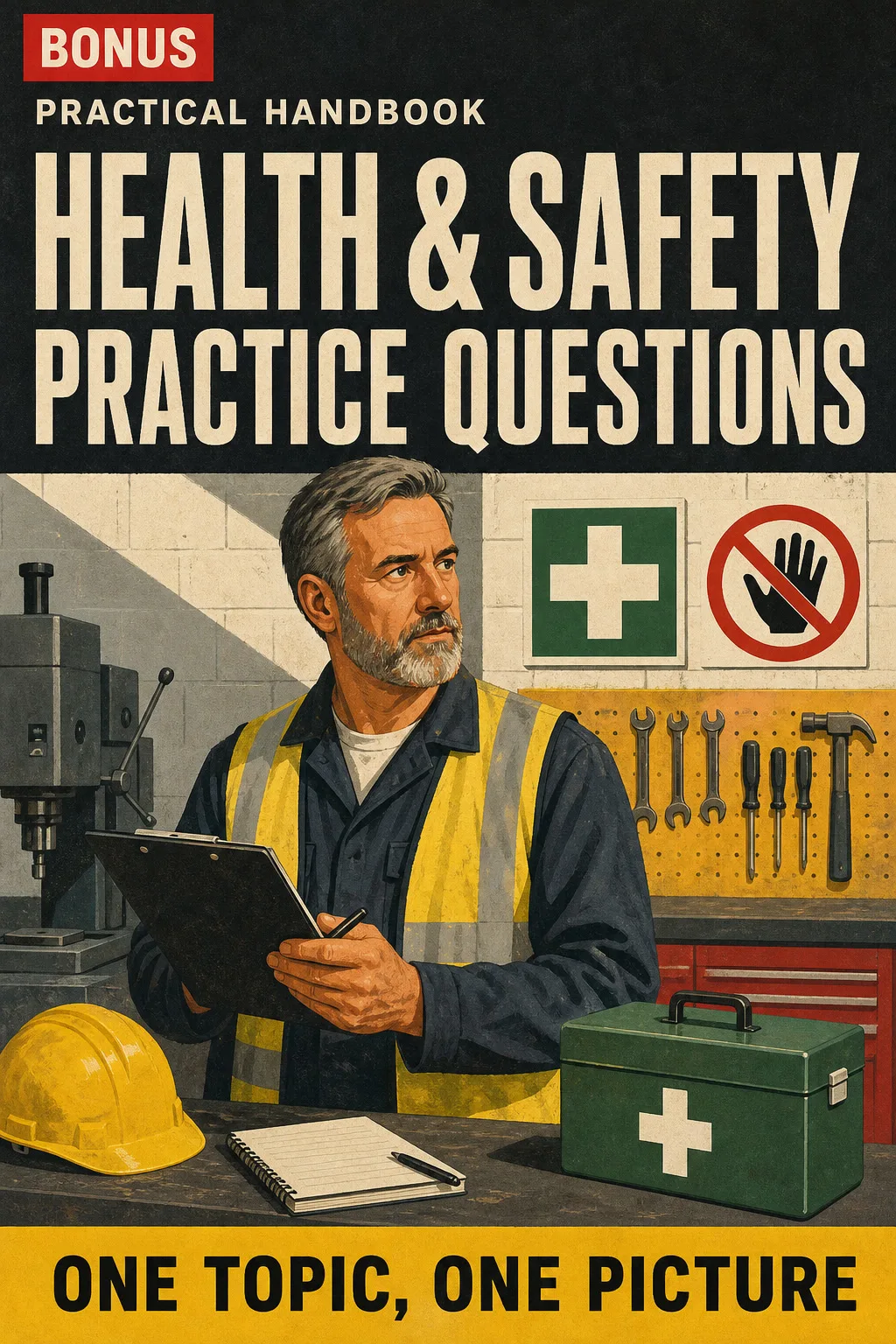
Health & Safety Practice Questions

BONUS 1: «Health & Safety Practice Questions»

Value on its own: US$ 17.90

Test yourself with exam-style questions on every topic, each answer explained and linked to the page it comes from, so you know what you've really understood.

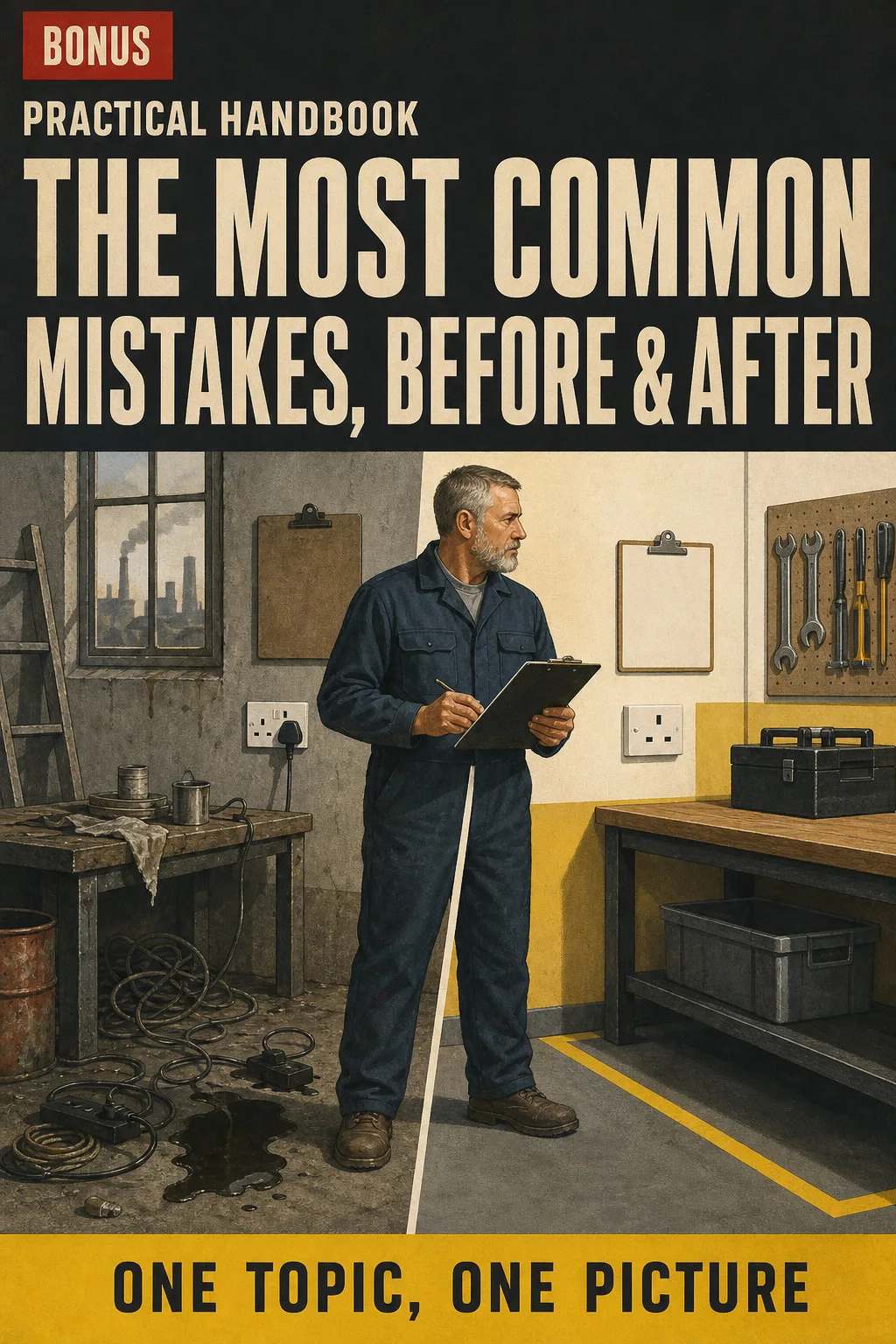
The Most Common Mistakes, Before & After

BONUS 2: «The Most Common Mistakes, Before & After»

Value on its own: US$ 14.90

The most frequent health and safety mistakes drawn side by side with the right way, so you spot them at a glance on site and in the exam.

Health & Safety Illustrated with 2 Free Books

  • Health & Safety Illustrated: 70 illustrated pagesUS$ 63
  • BONUS 1: Health & Safety Practice QuestionsUS$ 17.90
  • BONUS 2: The Most Common Mistakes, Before & AfterUS$ 14.90
  • High-resolution PDF to printIncluded
Total value US$ 95.80
YOUR PRICE:
US$ 27
You save US$ 68.80
YES, I WANT HEALTH & SAFETY ILLUSTRATED FOR US$ 27

📄 This is a digital PDF book sent to your email: nothing is printed or shipped.

Secure purchaseEncrypted payment30-day guarantee

PDF by email: We email you Health & Safety Illustrated as a PDF, together with the two free books. It's a single payment: no installments, no extra charges.

Who This Book Is For

You're on a health and safety course

You're on a health and safety course

Each acronym becomes a scene from work, one page at a time. You read the evening's topic and it's still there in the morning.

Your exam or site card test is close

Your exam or site card test is close

The revision part puts every acronym, year and number on a single page. You go over it the night before, in the same order every time.

You already run a team

You already run a team

The risk assessment in 5 steps, what to report under RIDDOR and the hierarchy of control, printed and kept to hand in the cabin or the office.

Everything You Get Today

US$ 95.80US$ 27
YES, I WANT HEALTH & SAFETY ILLUSTRATED FOR US$ 27

📄 This is a digital PDF book sent to your email: nothing is printed or shipped.

30DAYS
GUARANTEE

30-Day Guarantee

Try Health & Safety Illustrated for 30 days, bonus books included.

We refund everything if the file won't open, if the book isn't what you see here, if you were charged twice or if the email doesn't arrive. Just email us.

You pay once. No subscriptions.

Frequently Asked Questions

Is it for me if I've been in the trade for 20 years and haven't studied since school?

Yes. It doesn't teach you your job: it puts the law and the regulations in order, one topic per page, with the drawing first.

Where does the content come from?

From UK legislation: the Health and Safety at Work etc. Act 1974, the Management Regulations 1999, RIDDOR 2013, COSHH 2002, Work at Height 2005, PUWER and LOLER 1998, and HSE guidance such as INDG163 and HSG65.

Is it official material?

No. It's an independent study book. It isn't published or endorsed by the HSE or by any awarding body.

Does it replace the course or the training?

No. It's study material to go alongside your course. It doesn't give you a certificate or a site card, and it doesn't replace accredited training, a First Aid at Work course or professional advice.

Are the practice questions the ones from the exam?

No. They're written for this book to help you check what you've understood. They aren't official questions from any exam.

When and how does it arrive?

As a PDF by email, to the address you enter at checkout. The 2 free books come the same way. It's a single payment, with no subscription.

Does it work for my course: IOSH, NEBOSH, SSSTS, SMSTS or the CITB HS&E test?

It covers the UK law and topics these courses share: the 1974 Act, risk assessment, the hierarchy of control, COSHH, RIDDOR, work at height and fire. It isn't the official syllabus of any of them, so use it alongside your course notes.

Can I have it on paper?

Yes. It's a PDF you can print at home or at a print shop, all of it or just the pages you want to keep to hand.

How does the refund work?

You have 30 days. We refund everything if the file won't open, if the book isn't what you see on this page, if you were charged twice or if the email doesn't arrive: just email us.

Before You Close This Page

No more rereading with nothing sticking.

The hierarchy of control: you see it drawn, and that's it.

You walk into the exam knowing where everything is.

Drawings make studying faster.

The book is right below.

One-time payment: US$ 27 · Guarantee: 30 days · PDF by email

YES, I WANT HEALTH & SAFETY ILLUSTRATED FOR US$ 27

📄 This is a digital PDF book sent to your email: nothing is printed or shipped.